

Predictive AI for Time to Next Failure
A publication-style case study showing how KnowVerse converts a simple layman query into a live predictive application that forecasts equipment failure lead time for fracking operations and helps field teams act before unplanned shutdowns occur.
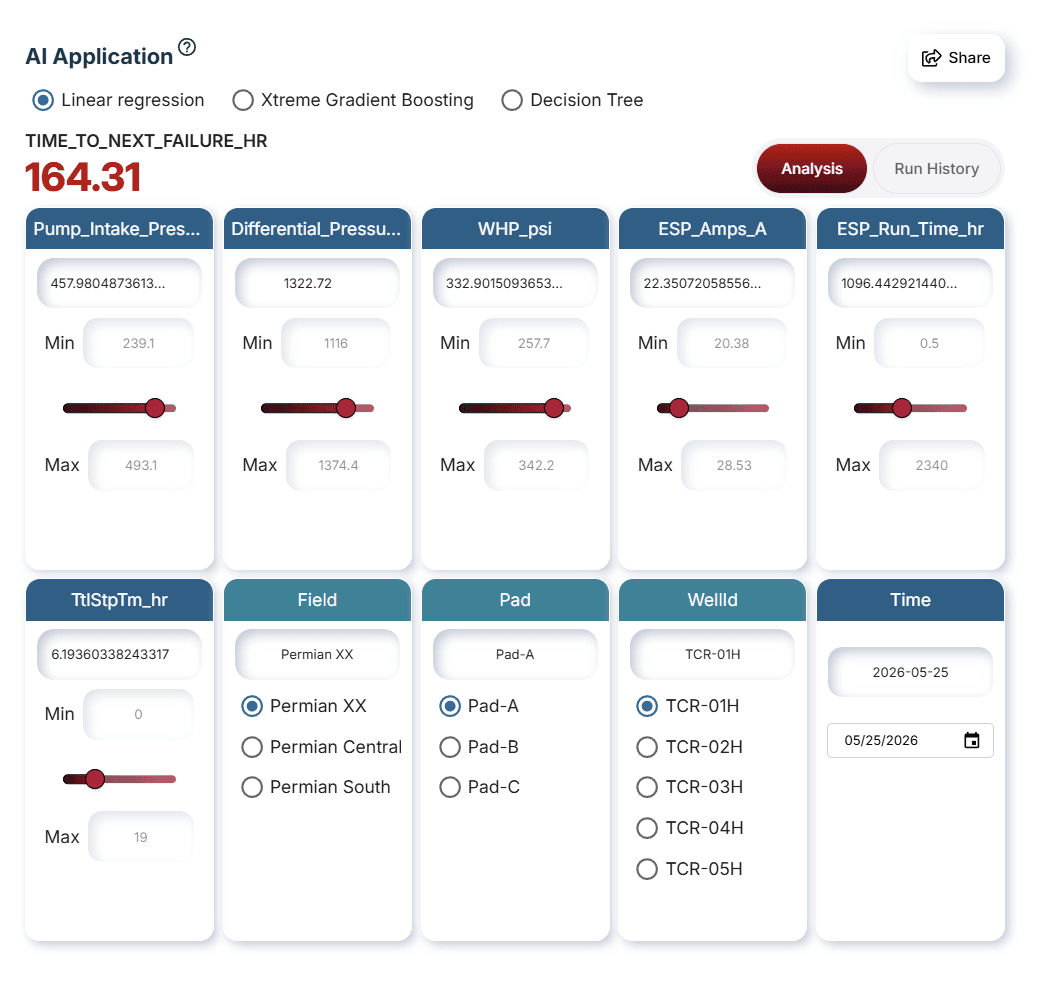
Failure timing is hidden inside historian signals, not in a single obvious alarm.
Industry challenge
Fracking and well equipment failures are typically preceded by subtle shifts in pressure, current draw, runtime, stop-time patterns, and site-specific behavior. In practice, those signals live across historian streams, well metadata, operational tags, and maintenance records, making it difficult for teams to convert raw data into a reliable estimate of when the next failure is likely to occur.
Business impact
Predicting time to next failure helps operators intervene before pump trips or equipment breakdowns cause deferred production, emergency callouts, and reactive maintenance spend. The economic value comes from reducing unplanned shut-ins, improving crew scheduling, and using predicted lead time to prioritize the right wells at the right moment.
KnowVerse retrieved the data, built the model workflow, and generated the prediction application autonomously.
Data and sources considered
The workflow considered well-site historian and operational data including location and asset identifiers (Field, Pad, WellId, Lat, Long, Time), pressures (Pump Intake, Differential Pressure, WHP, FLP, Casing, Riser, Pump Discharge), ESP and electrical behavior (ESP Amps, Voltage, Frequency, Run Time, current leak), mechanical indicators (vibration, motor temperature), choke settings, run/stop durations, operating status, and fault context. The primary regression target was Time_to_Next_Failure_hr, with Equipment_Failure_Severity identified as another high-value future target.
Autonomous retrieval
KnowVerse autonomously retrieves the relevant time-series and metadata from the organization historian and internal repositories, identifies the candidate predictive target, and assembles the important inputs without requiring manual data engineering or specialist prompt crafting from the user.
Execution-engine analysis
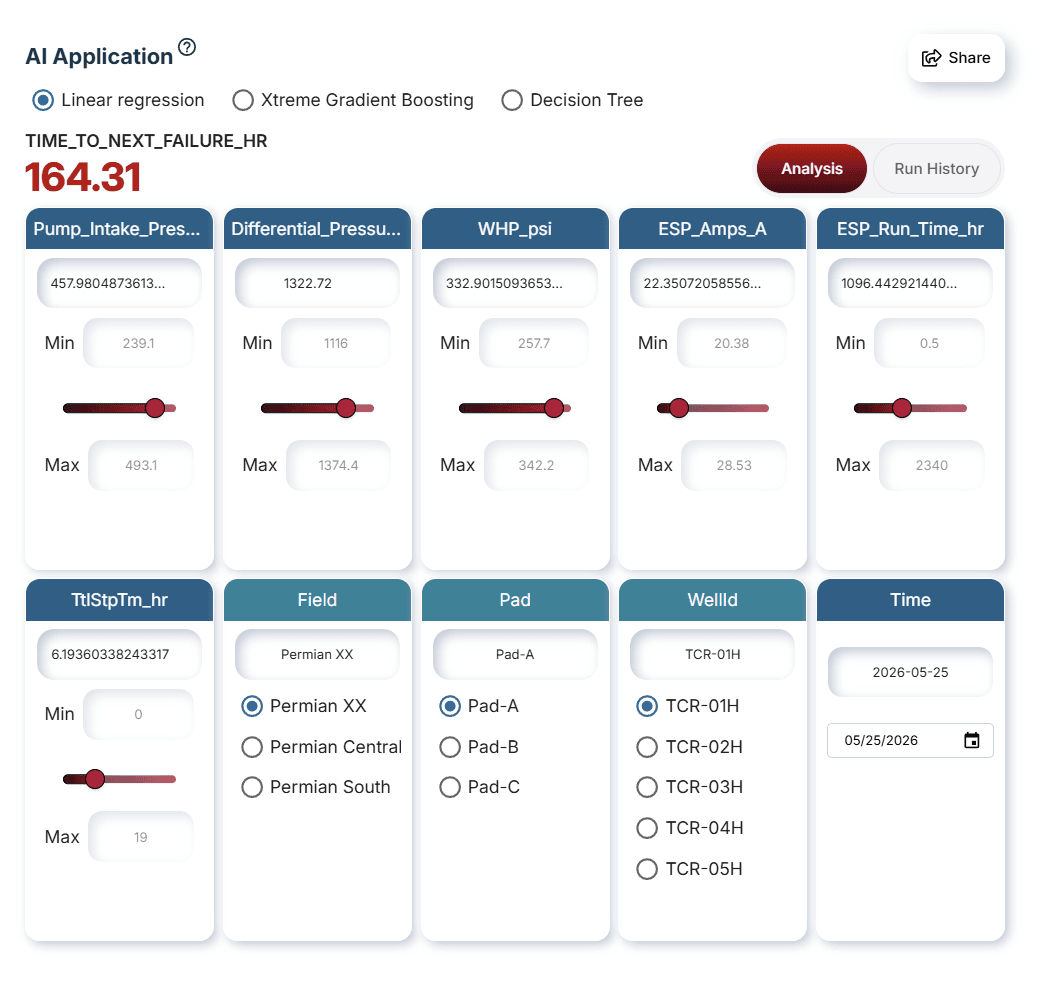
The platform built a reusable predictive AI application by training, validating, and comparing Linear Regression, Xtreme Gradient Boosting, and Decision Tree models, then automatically producing diagnostics, feature-importance views, error trends, what-if controls, and an on-demand prediction interface for operational use.
The low-error models turned historical sensor behavior into an early-warning maintenance window.
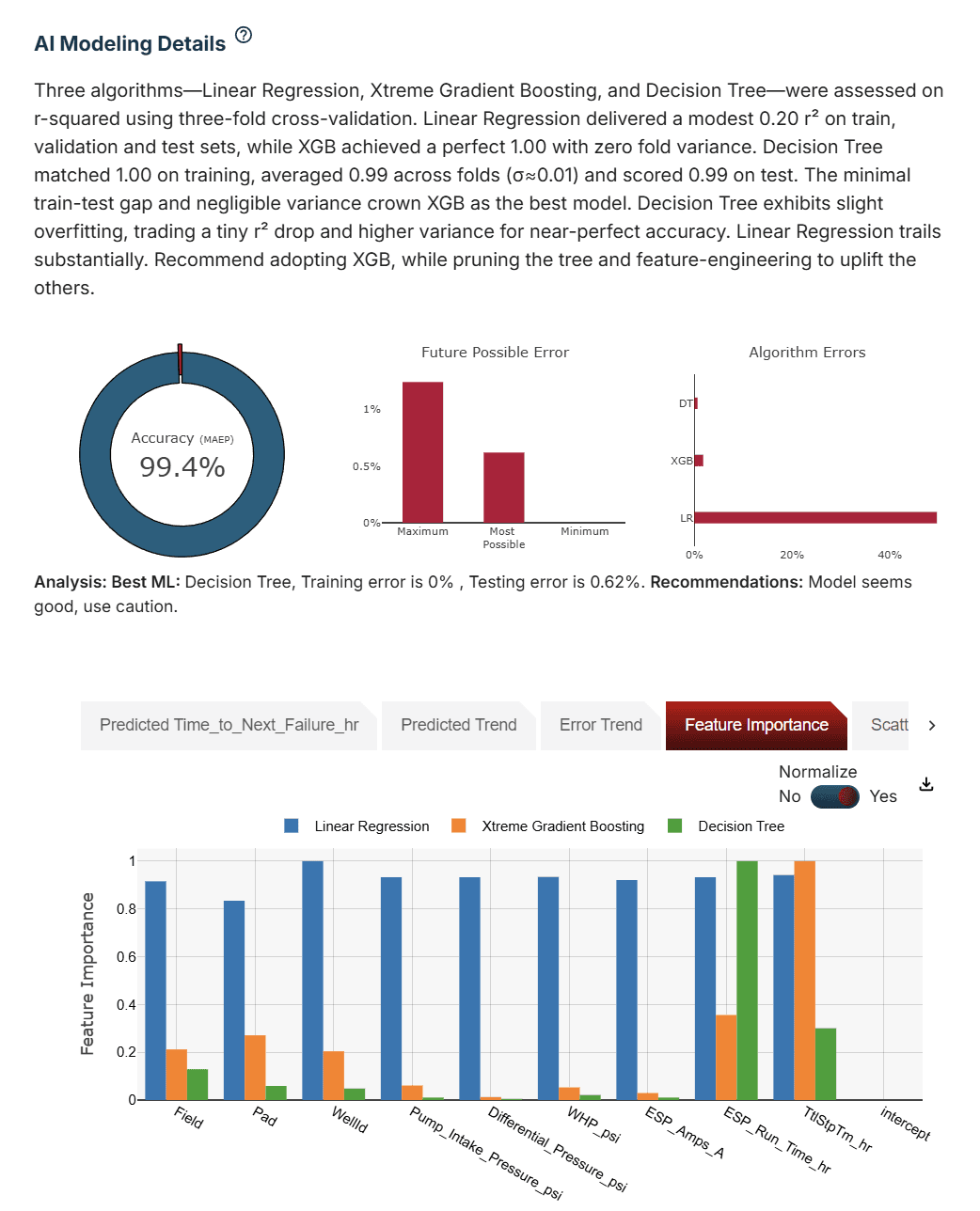
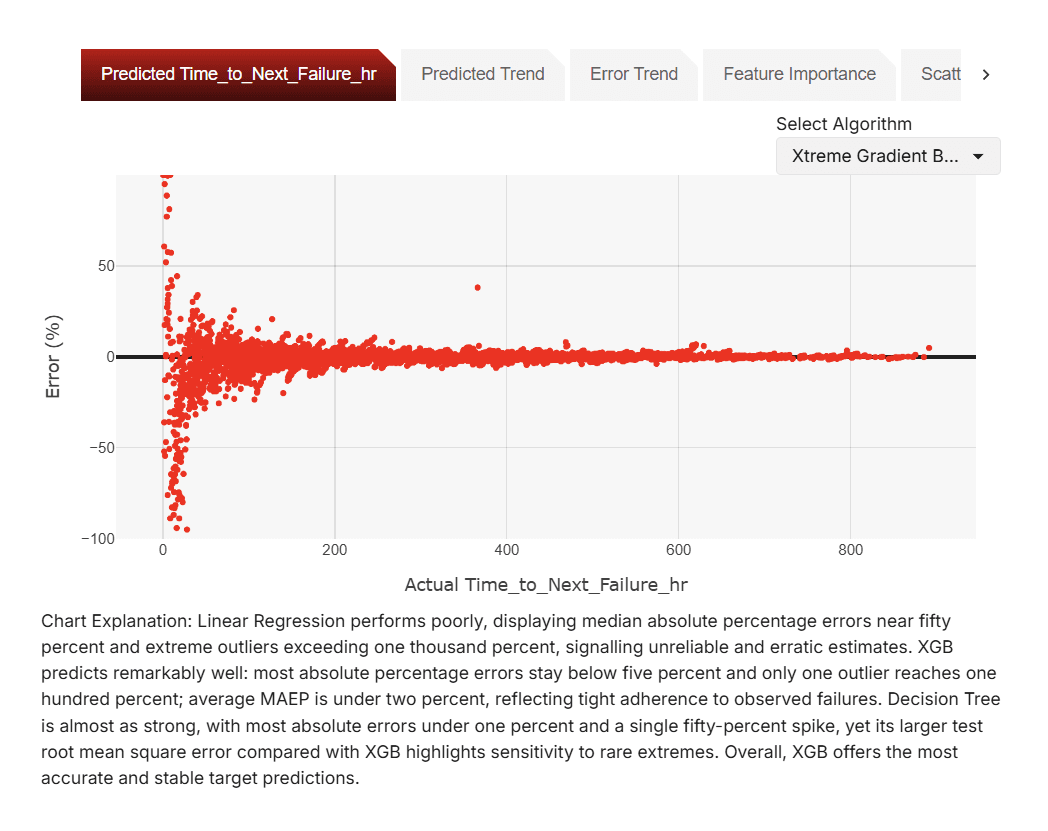
KnowVerse acts as a governed predictive execution engine—not merely a chatbot that suggests ideas.
| Approach | How the work happens | Accuracy and financial impact |
|---|---|---|
| Traditional reliability workflow | Analysts extract historian tags, join multiple tables, engineer features, build models separately, validate results manually, and then hand over dashboards or spreadsheets to operations. | Technically possible but slow, specialist-dependent, and hard to scale. Financial value is delayed because prediction workflows are not easily reusable and interventions arrive later. |
| ChatGPT / Copilot / Grok / Claude | Generic AI can propose model ideas, explain algorithms, or draft code, but the user still needs to prepare the data, execute the training pipeline, validate outputs, and package the result into an operational application. | Helpful for assistance, but accuracy depends on user skill, prompt quality, and manual validation. It does not by itself become a controlled predictive asset embedded in operations. |
| KnowVerse execution engine | The system retrieves internal data, identifies the target, trains competing models, selects and explains the best candidates, and then creates a reusable predictive application with scenario testing and visual diagnostics. | Higher operational confidence and financial value because outputs are grounded in internal data, model performance is visible, and field teams can act earlier to avoid downtime, reduce deferred production, and deploy maintenance crews more efficiently. |
Executive takeaway
KnowVerse demonstrates how generative, agentic, and predictive AI can move beyond simple Q&A and become an autonomous industrial application builder. In this case, it turns real-time well-site signals into a reliable failure-lead-time forecast that supports proactive maintenance, better production continuity, and more financially disciplined field operations.