


Predicting Candidate Hiring Decisions in Recruitment
Optimizing recruitment decisions by analyzing candidate profiles and performance trends.
1Overview & Strategic Importance

Problem Statement
The recruitment process is a critical operation for organizations, impacting talent acquisition and overall workforce quality. Hiring managers and HR professionals often rely on subjective judgment when evaluating candidates, leading to inconsistencies and inefficiencies in decision-making. The dataset provides information about candidates' demographics, qualifications, and evaluation scores, making it possible to predict hiring outcomes. This enables HR teams to identify patterns, streamline hiring processes, and improve decision accuracy through data-driven insights.
Required Solutions
- Analyzing key candidate attributes influencing hiring decisions.
- Developing a machine learning model to predict the likelihood of hiring based on candidate profiles.
- Recommending strategies to enhance recruitment practices and identify top talent effectively.
Solution Objectives
- Conduct exploratory data analysis to identify trends in hiring patterns.
- Build a binary classification model to predict hiring outcomes (HiringDecision).
- Evaluate feature importance to understand which attributes significantly influence hiring.
- Provide actionable recommendations to refine recruitment and decision-making strategies.
Understanding the Problem
Hiring decisions are influenced by several factors, such as candidate qualifications, professional experience, technical and personality assessments, and proximity to the workplace.
Organizations aim to minimize bias, reduce hiring time, and ensure the selection of candidates who align with the company's needs and values.
2About the Data
Data Collection
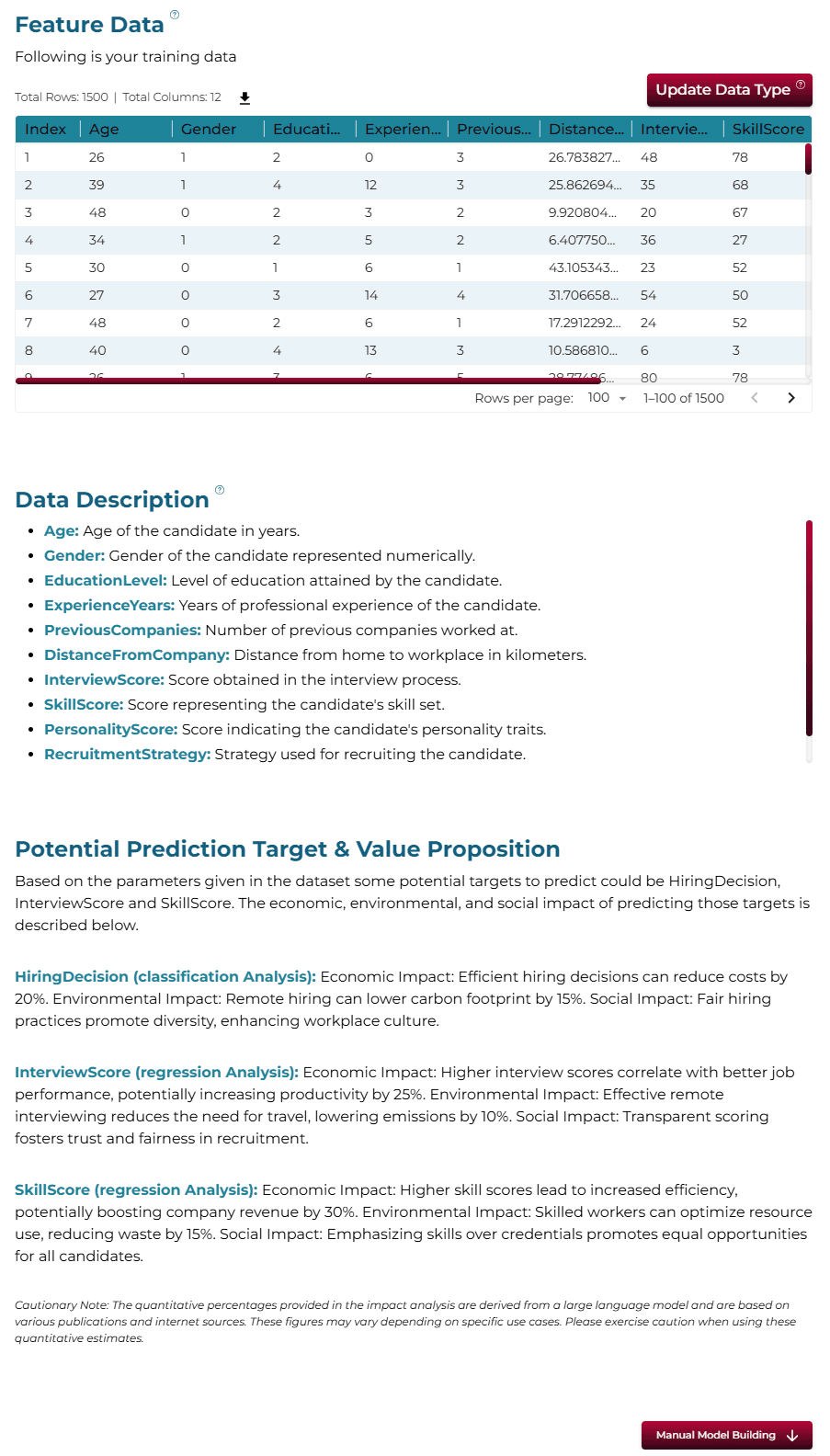
The dataset comprises 1,500 records representing candidate profiles, collected during recruitment processes. Each record includes variables related to personal attributes, professional qualifications, and evaluation scores.
Major Parameters Description
Download Training DataAgeAge of the candidate (20–50 years).
GenderGender of the candidate (0 = Male, 1 = Female).
Education LevelHighest level of education attained (1 = Bachelor’s Type 1, 2 = Bachelor’s Type 2, 3 = Master’s, 4 = PhD).
Experience YearsNumber of years of professional experience (0–15 years).
Previous Companies WorkedNumber of companies where the candidate has worked (1–5 companies).
Distance From CompanyDistance from the candidate’s residence to the company (1–50 km).
Interview ScoreScore achieved in the interview process (0–100).
Skill ScoreAssessment score of the candidate’s technical skills (0–100).
Personality ScoreEvaluation of the candidate’s personality traits (0–100).
3Using iDareAI
Guided Mode Initialization
AUploading Dataset
Click on the **'Upload CSV or Excel Data'** button → Select a source for the dataset → Upload `recruitment_decision_train.csv`. The system automatically analyzes the file, extracts column descriptions, and identifies the top value-adding targets for prediction.
BChoosing Analysis Mode
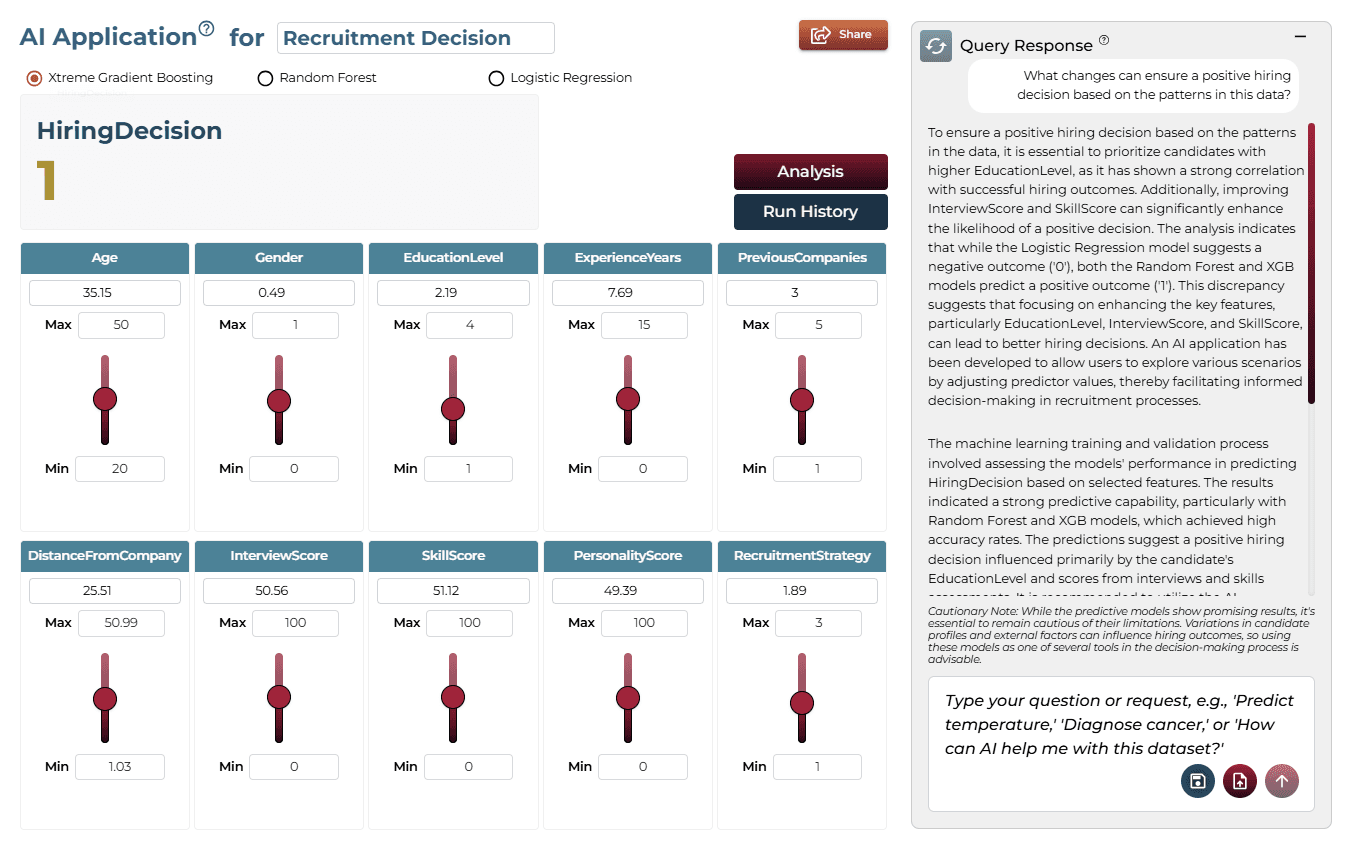
- What changes can ensure a positive hiring decision based on the patterns in this data?
- Which factors in the data have the biggest impact on hiring decision?
Operation Using Autonomous Guided Mode
AQuery Response
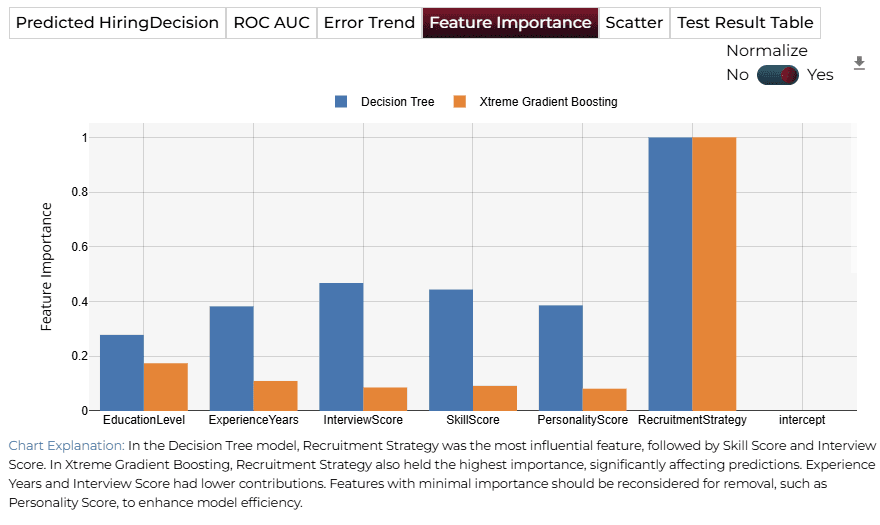
Organizations should prioritize candidates with higher EducationLevel, as it has shown the most significant impact on hiring outcomes. Enhancing SkillScore and InterviewScore further improves hiring probability.
BAI Application
The system generates an automated AI application on-demand. Users can leverage sliders to explore various scenarios and adjust predictor values to find desired hiring outcomes.
Model Fine-Tuning/Manual Model Building
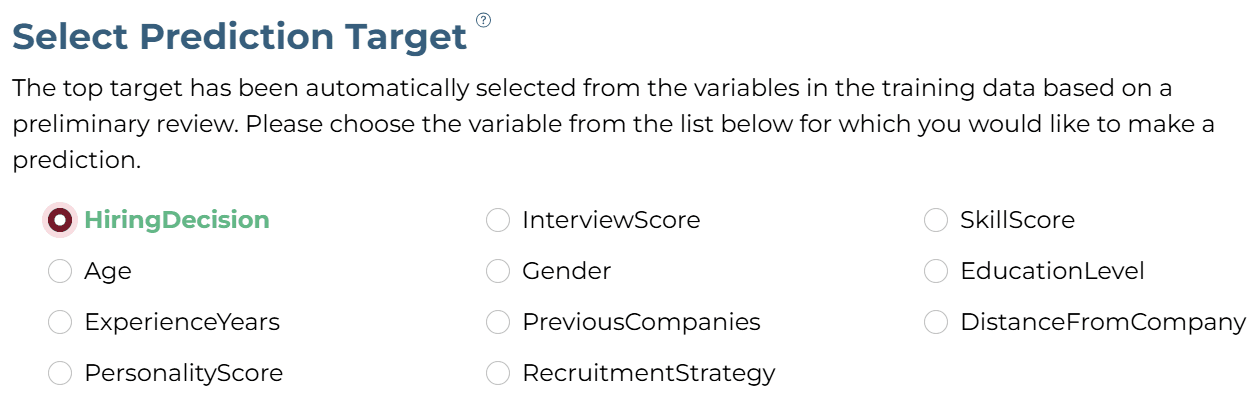
ASelecting Prediction Target
'HiringDecision' column was selected as the target.
BSelecting Analysis Type
The analysis target is a categorical column. Hence, the 'Classification' analysis type is selected.

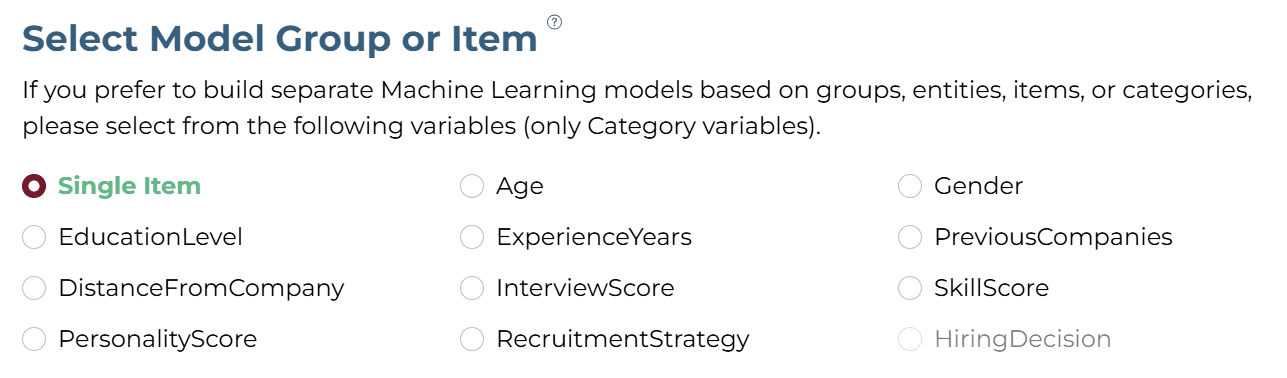
CSelecting Model Group/Item
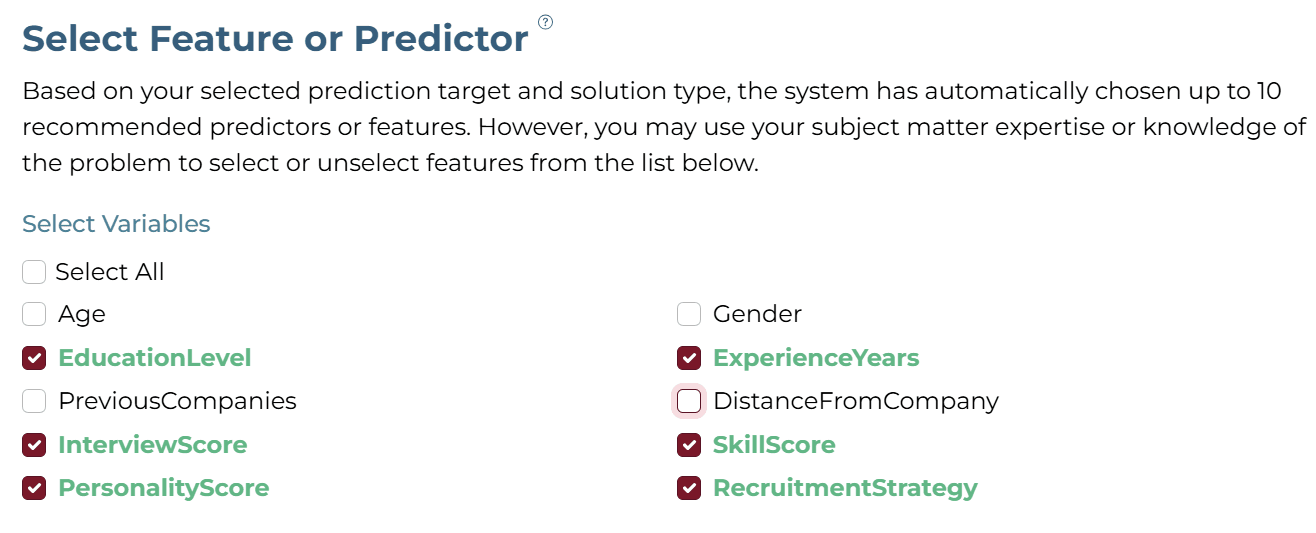
DSelecting Features
Select all relevant candidate attributes for the predictive model.
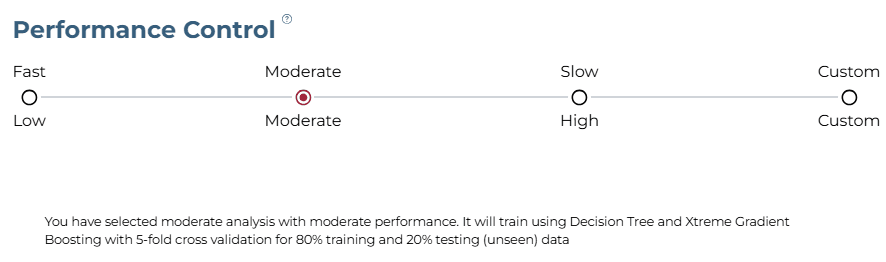
ESelecting Training Level
The "Slow" training level with "High Performance" configuration was selected for thorough analysis.
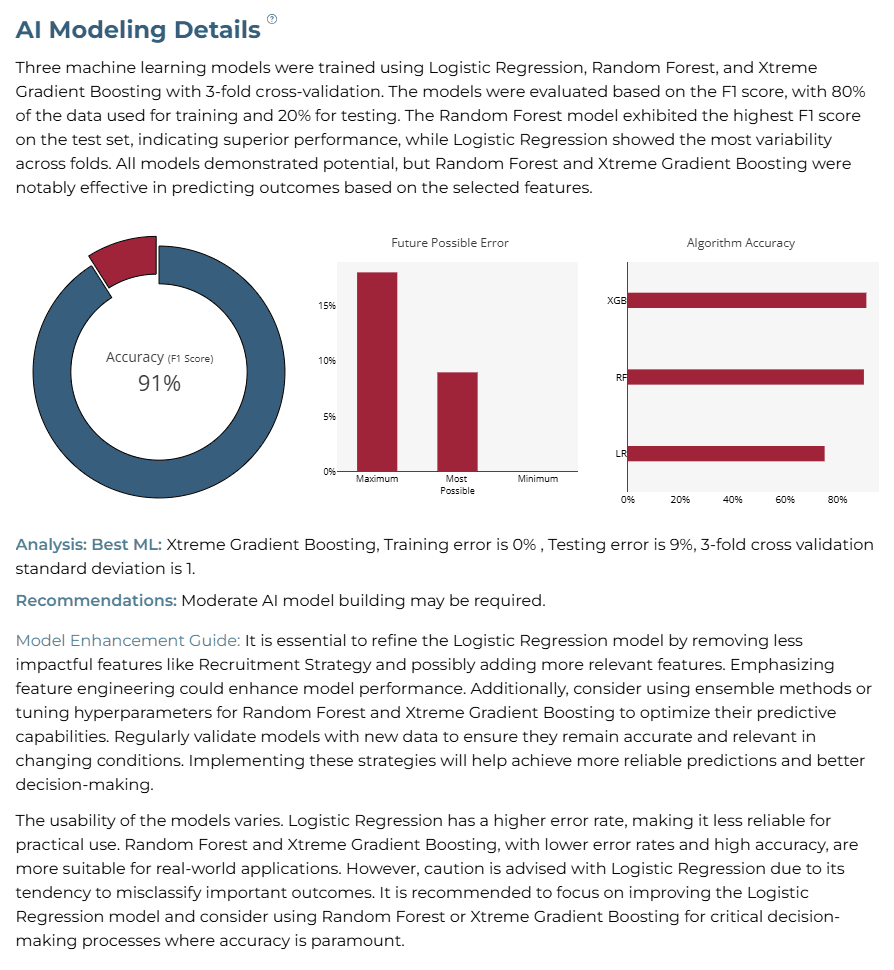
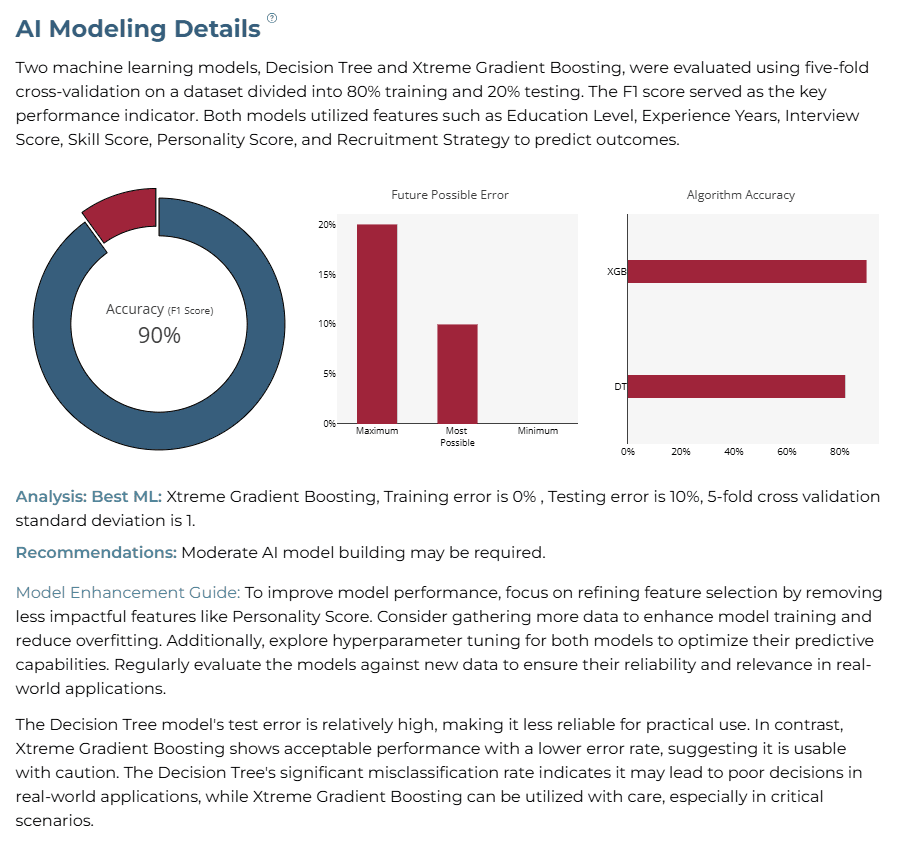
AI Modeling Details
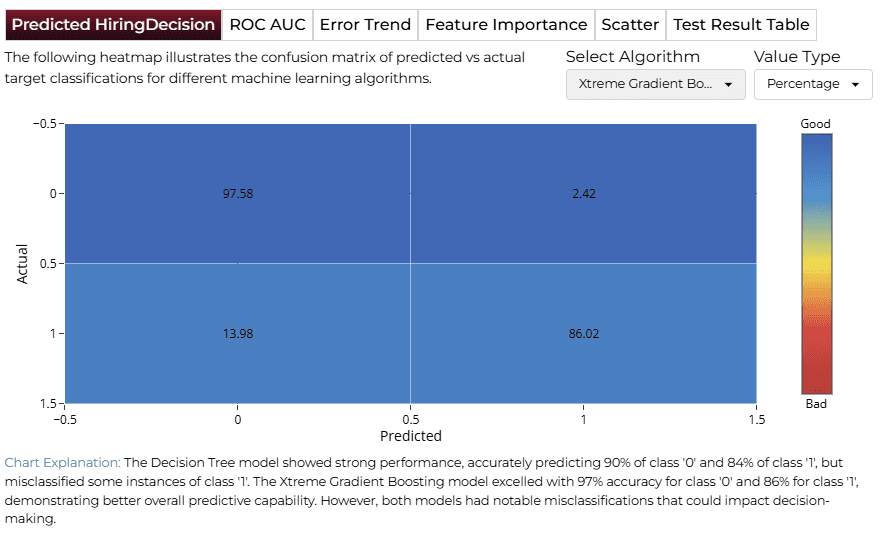
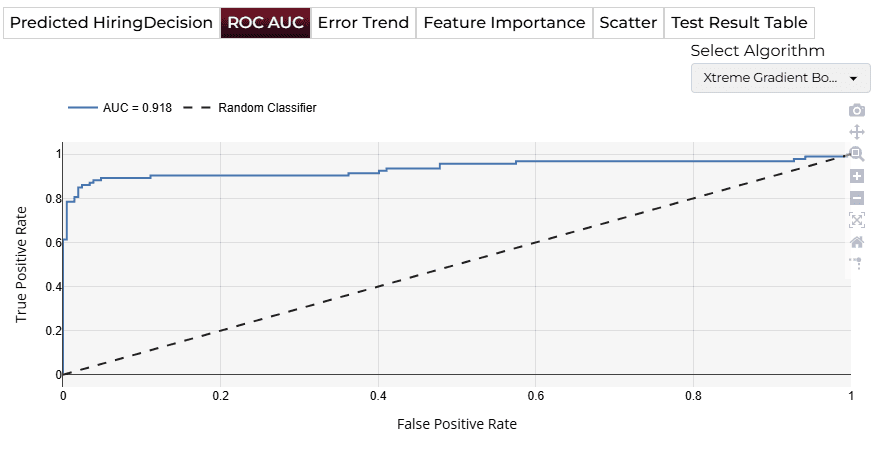
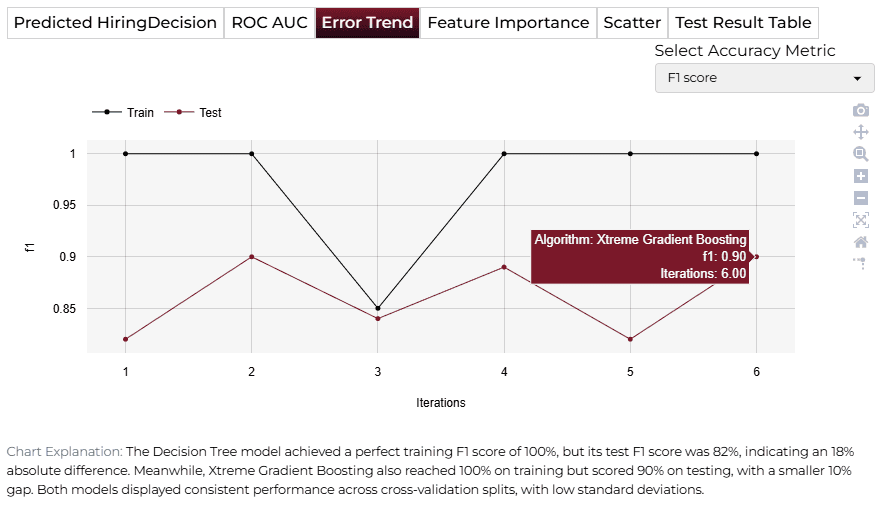
XGB is considered the best ML model for recruitment decisions, offering the highest accuracy and lowest possible error percentages.
Training Analysis Details
APredicted Target
BROC AUC
CError Trend
DFeature Importance
Finalize Models
Once satisfied with performance, click 'Deploy'. The system saves and deploys models for real-time hiring predictions.

4AI APPLICATION
Manual Model Building
In Manual Training Mode, users can adjust sliders for variables like ExperienceYears, EducationLevel, and SkillScore. The analysis dynamically updates to show how specific factors influence actual hiring outcomes.
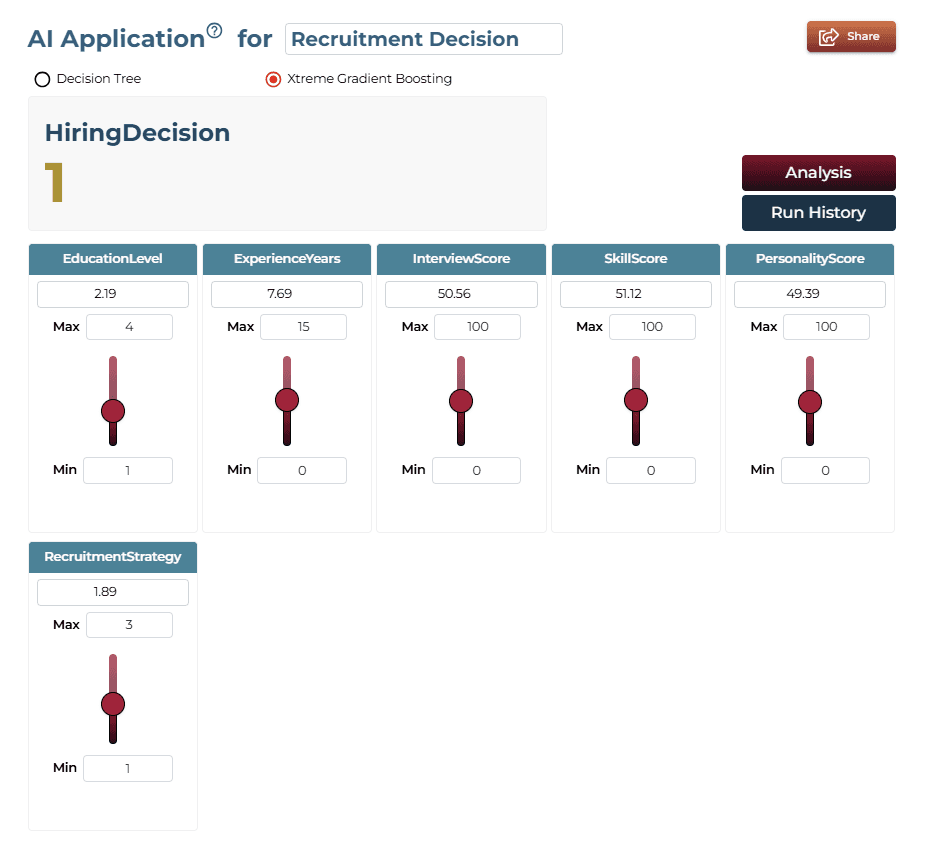
AI Application Demo
In this application, variables like ExperienceYears and SkillScore affect the result significantly. High values for these metrics typically yield a positive Hiring Decision prediction.
Saving the Project
Save your project by clicking the icon at the bottom left corner of the textbox.

Sharing the Project
Share the application for single on-demand predictions once the analysis is saved.

Interested in similar AI solutions?
Explore our full suite of AI capabilities designed to transform your business operations.