


Predicting Water Quality for Safe Consumption
Ensuring water safety by predicting water quality based on chemical composition, environmental factors, and contamination levels.
1Overview & Strategic Importance

Problem Statement
Ensuring safe and clean water for consumption is a critical public health priority. Contaminated water can carry harmful substances such as bacteria, heavy metals, and chemical pollutants. Traditional laboratory methods can be time-consuming and costly. A predictive model capable of assessing water quality based on key chemical and physical parameters can monitor contamination levels more efficiently, allowing for proactive interventions.
Required Solutions
- Analyzing historical water quality data to identify key parameters affecting safety.
- Developing classification models to categorize water samples as safe or unsafe for consumption.
- Providing an efficient and scalable solution for real-time water quality assessment.
Solution Objectives
- Perform exploratory data analysis to understand relationships between water indicators.
- Develop classification models to predict water safety based on composition.
- Provide insights for policymakers and water treatment facilities in monitoring efforts.
Understanding the Problem
Water quality is influenced by factors like pH, dissolved oxygen, and turbidity. Excessive pollutants can cause severe health problems.
Machine learning models assist in identifying patterns and predicting contamination levels. While valuable, these models complement rather than replace laboratory testing.
2About the Data
Data Collection
This dataset consists of water quality measurements in an urban environment. It is recommended for educational purposes to acquire knowledge in environmental monitoring and predictive analytics.
Major Water Quality Indicators
Download Training DatapHThe measure of acidity or alkalinity of water, which affects its suitability for consumption and aquatic life.
TurbidityThe cloudiness or haziness of water caused by suspended particles, which impacts water quality and treatment efficiency.
Dissolved OxygenThe amount of oxygen dissolved in water, essential for aquatic life and an indicator of water purity.
ConductivityThe ability of water to conduct electricity, which reflects the presence of dissolved salts and minerals.
Total Dissolved Solids (TDS)The concentration of dissolved substances in water, affecting its taste and potability.
ChlorineA disinfectant commonly added to water supplies to eliminate harmful bacteria and pathogens.
NitrateA chemical compound that can contaminate water due to agricultural runoff and pose health risks at high levels.
SulfateA naturally occurring mineral in water that, in high concentrations, can affect taste and health.
HardnessA measure of calcium and magnesium levels in water, which impacts household plumbing and soap efficiency.
3Using iDareAI
Guided Mode Initialization
AUploading Dataset
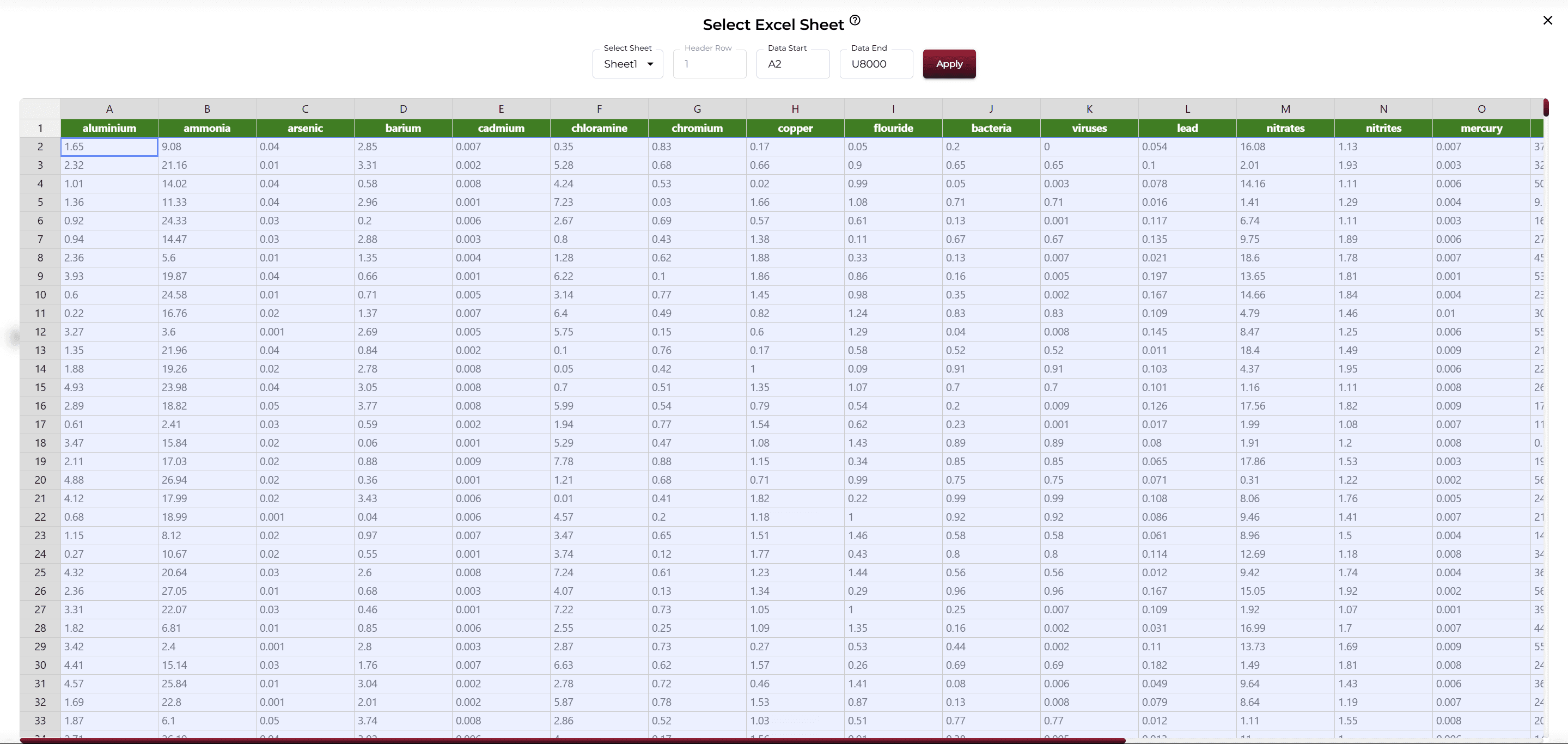
Click on the **'Upload CSV or Excel Data'** button → Select a source for the dataset → Upload `water_quality_train.xlsx`. The system automatically analyzes the file for environmental feature extraction.
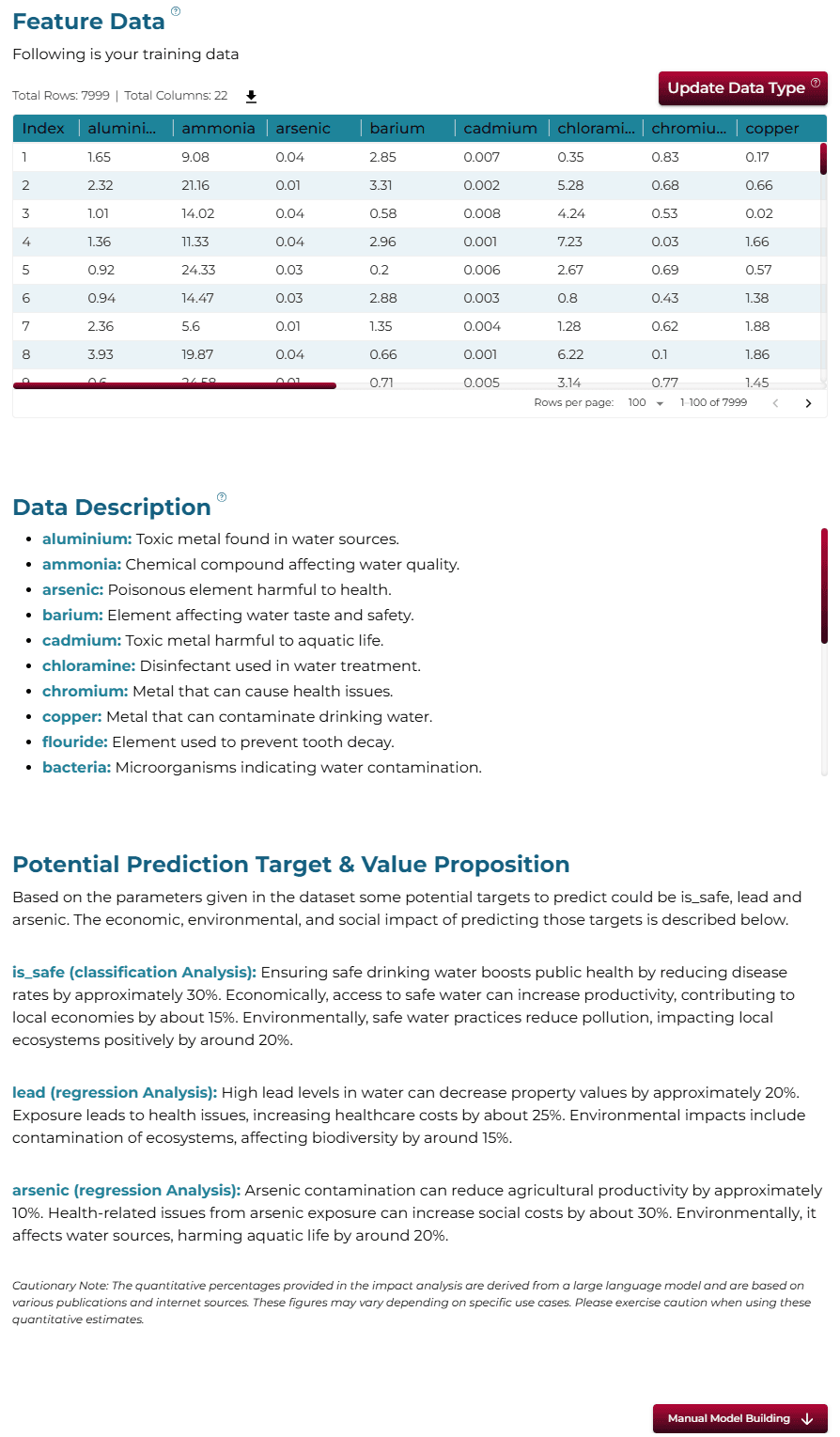
BChoosing Analysis Mode
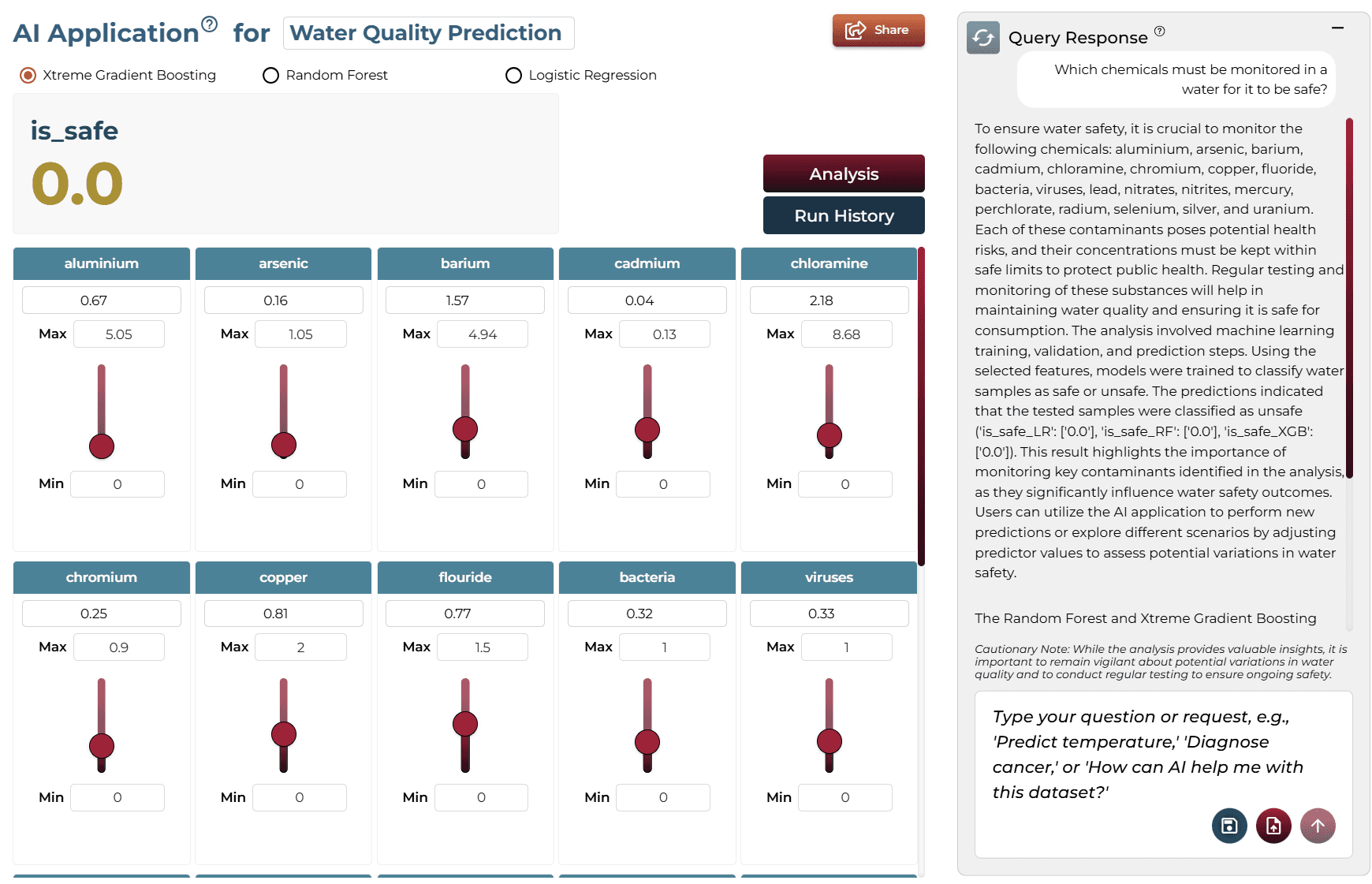
- Which chemicals must be monitored in a water for it to be safe?
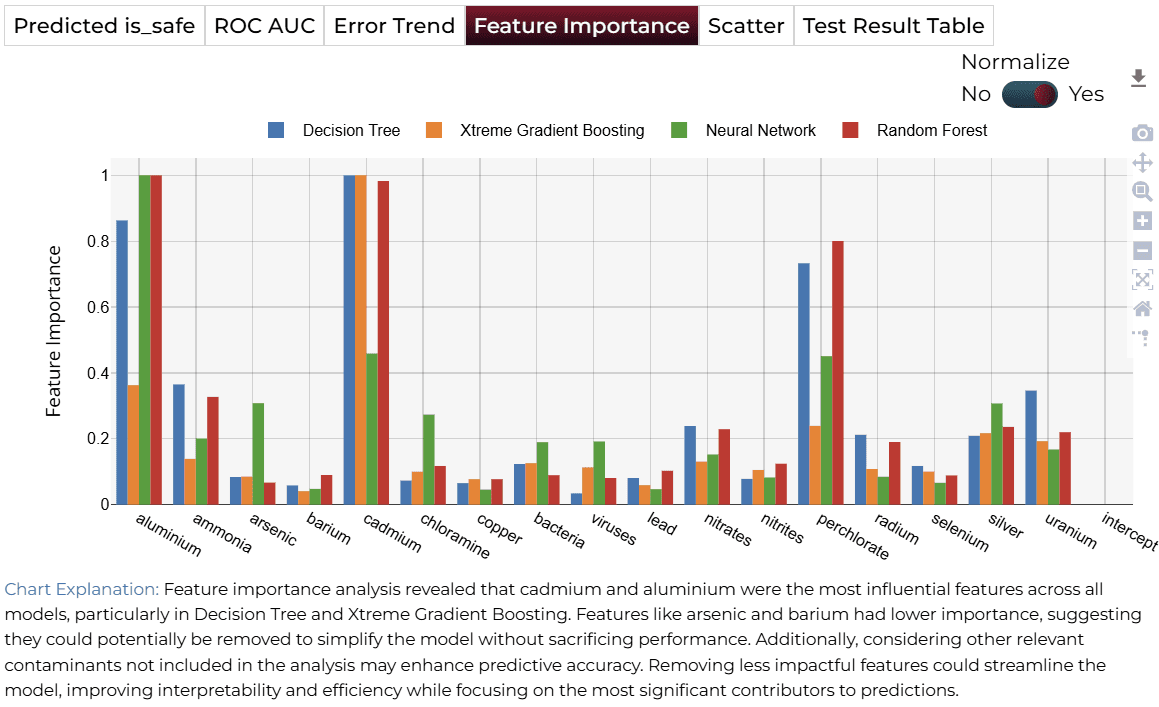
- Which factors play the most important role in the safety of water?
Operation Using Autonomous Guided Mode
AQuery Response
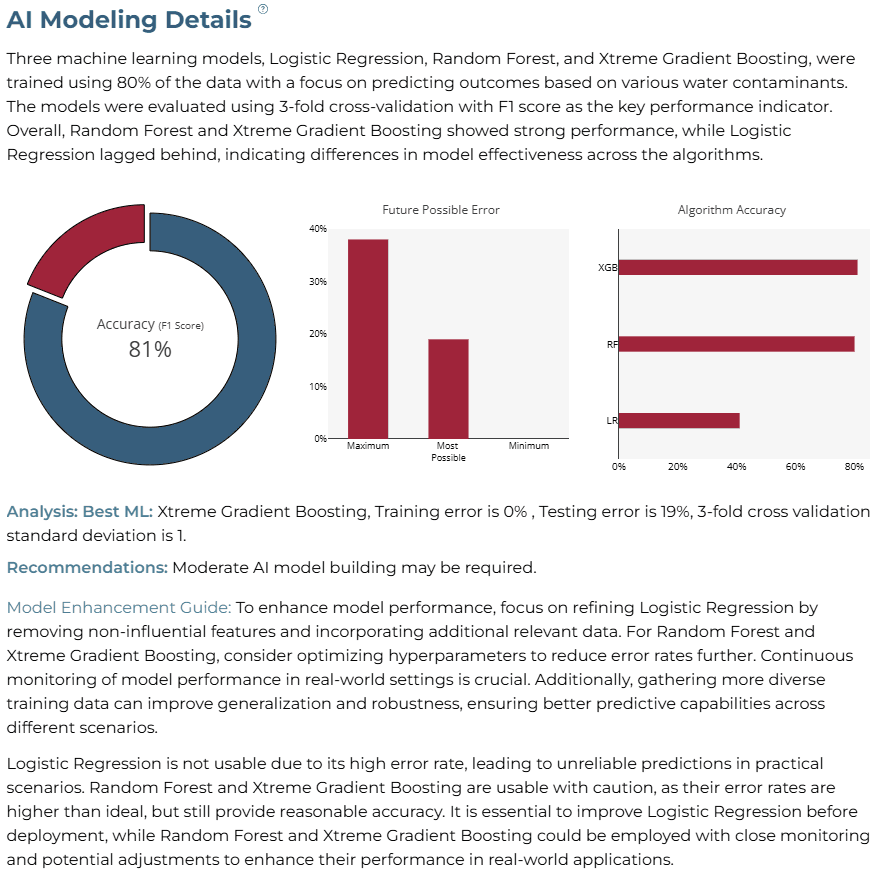
The Random Forest model demonstrated the best performance with 97% accuracy. It identified bacterial and arsenic concentrations as significant safety influencers.
BAI Application
The system generates an automated interface with sliders to explore scenarios. The Random Forest model is categorized as comfortably usable for environmental assessments.
Model Fine-Tuning/Manual Model Building
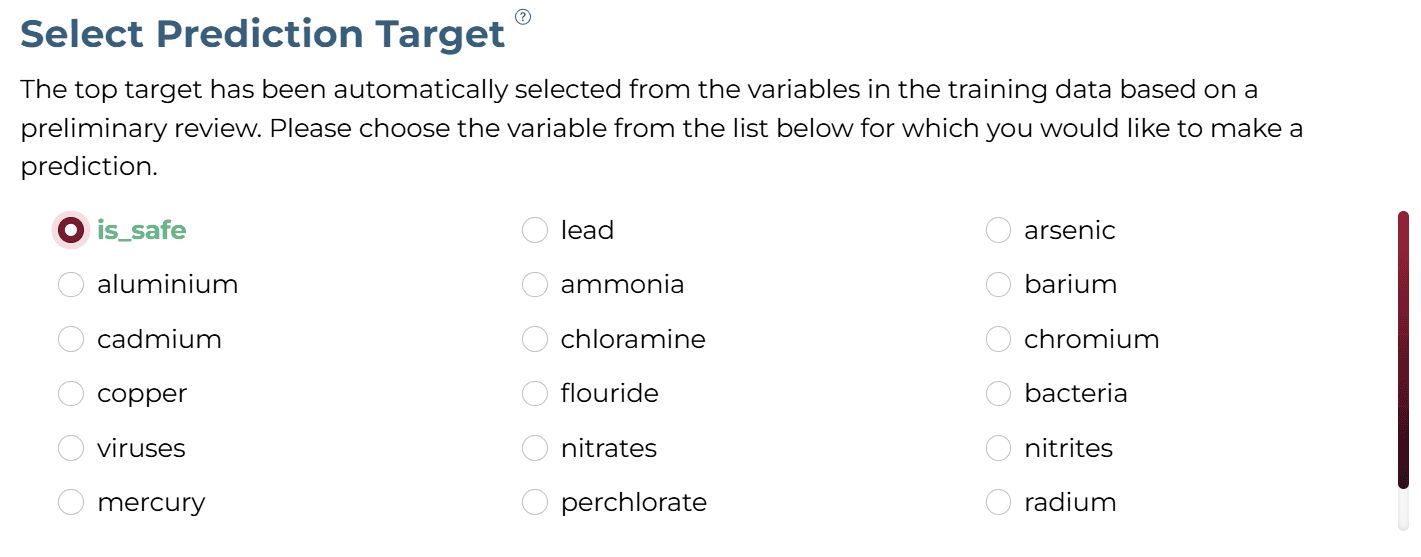
ASelecting Prediction Target
'is_safe' was selected as the target column.
BSelecting Analysis Type
Categorical classification (0 or 1) is selected to distinguish safe from unsafe water.

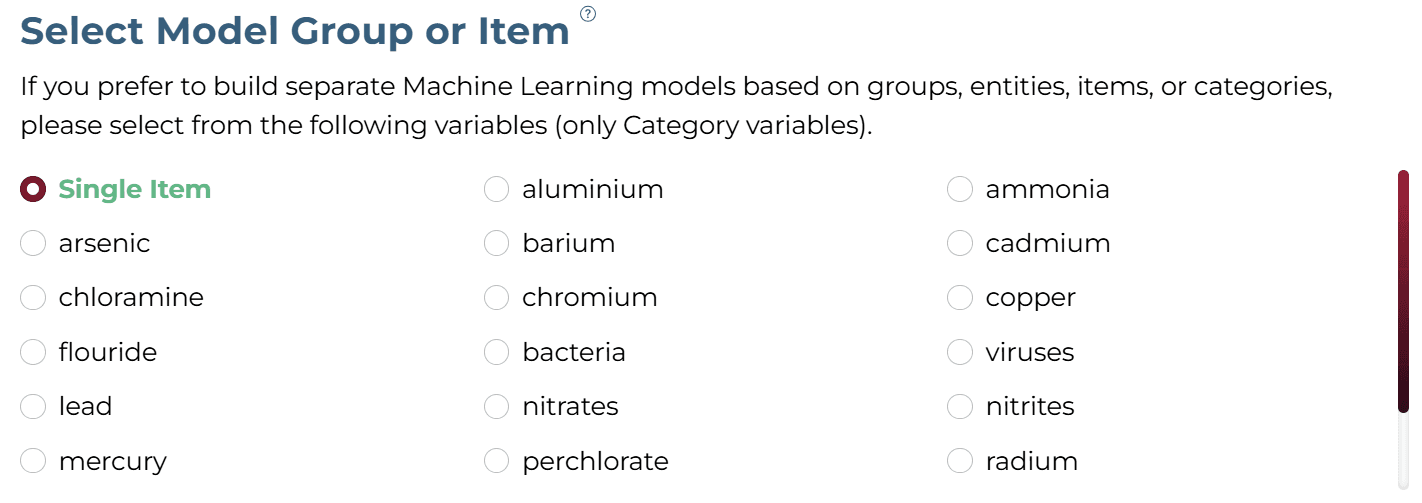
CSelecting Model Group/Item
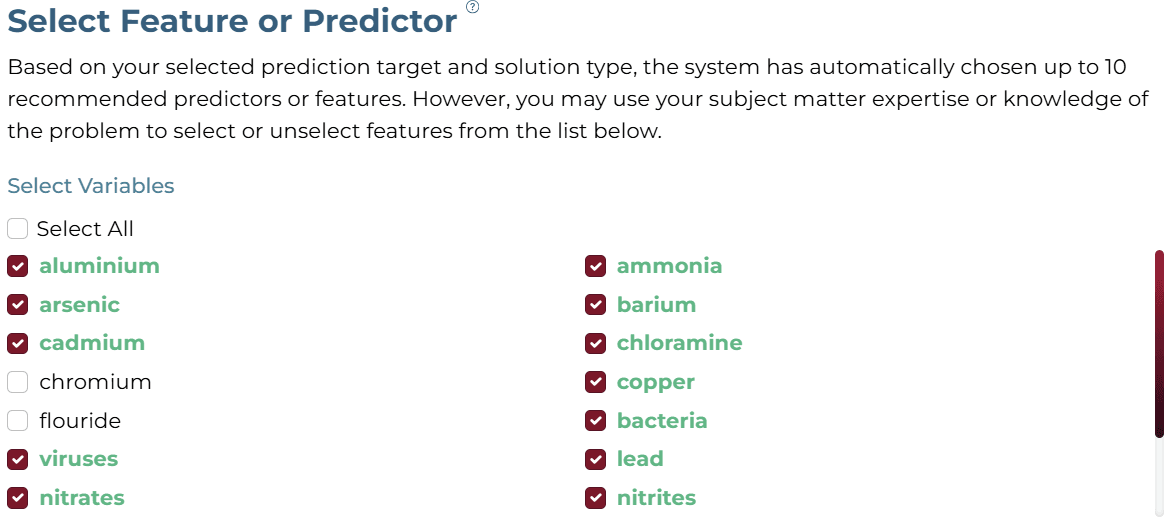
DSelecting Features
Select indicators such as aluminium, arsenic, bacteria, lead, and nitrates.
ESelecting Training Level

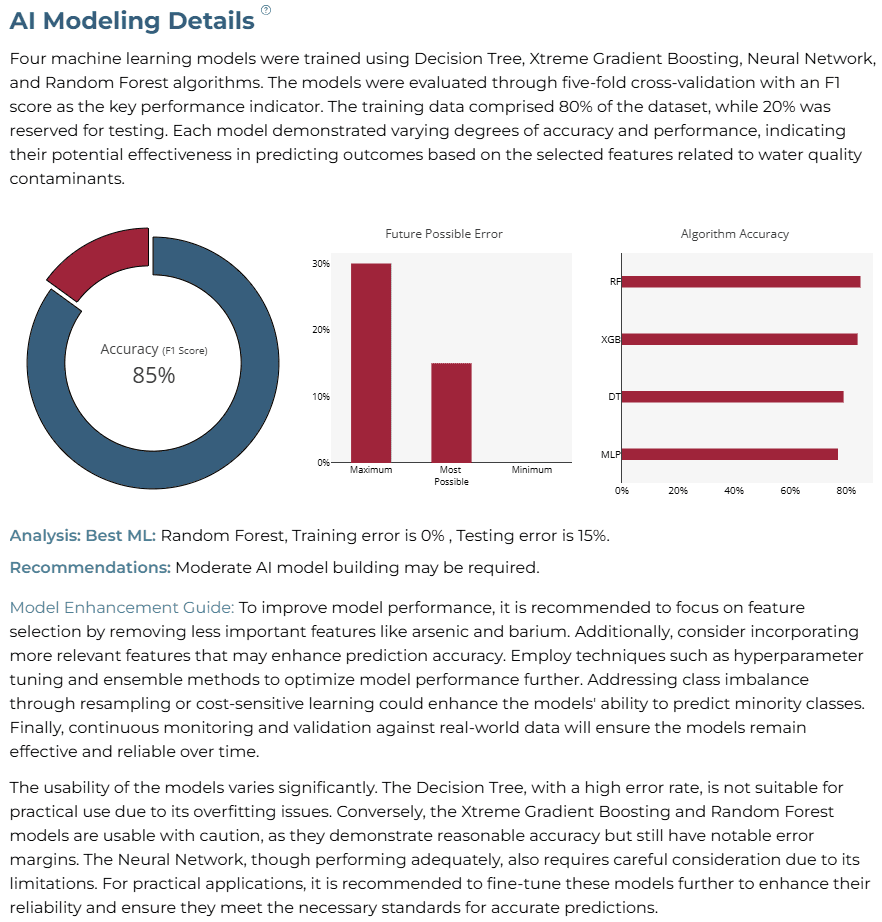
AI Modeling Details
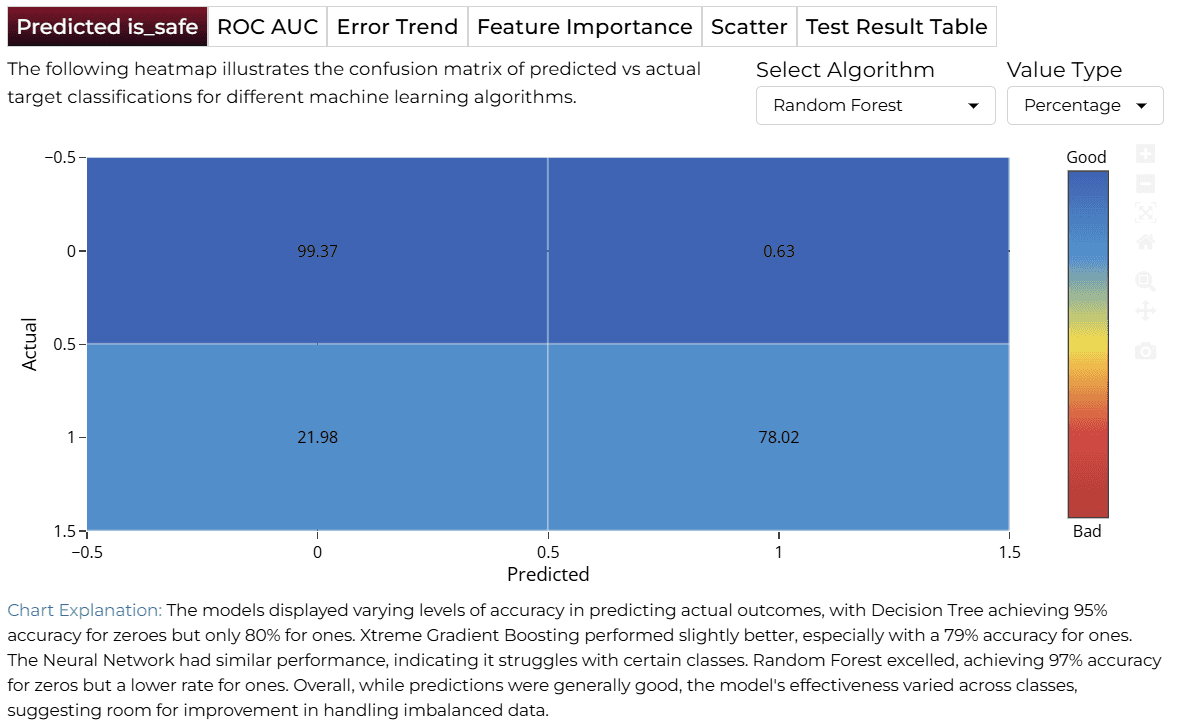
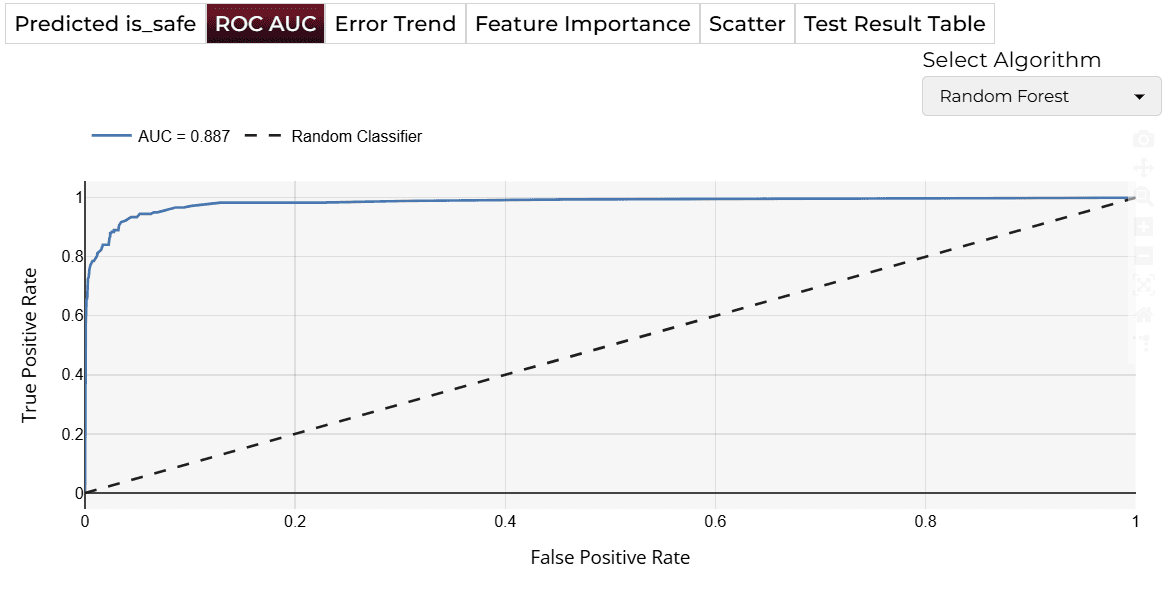
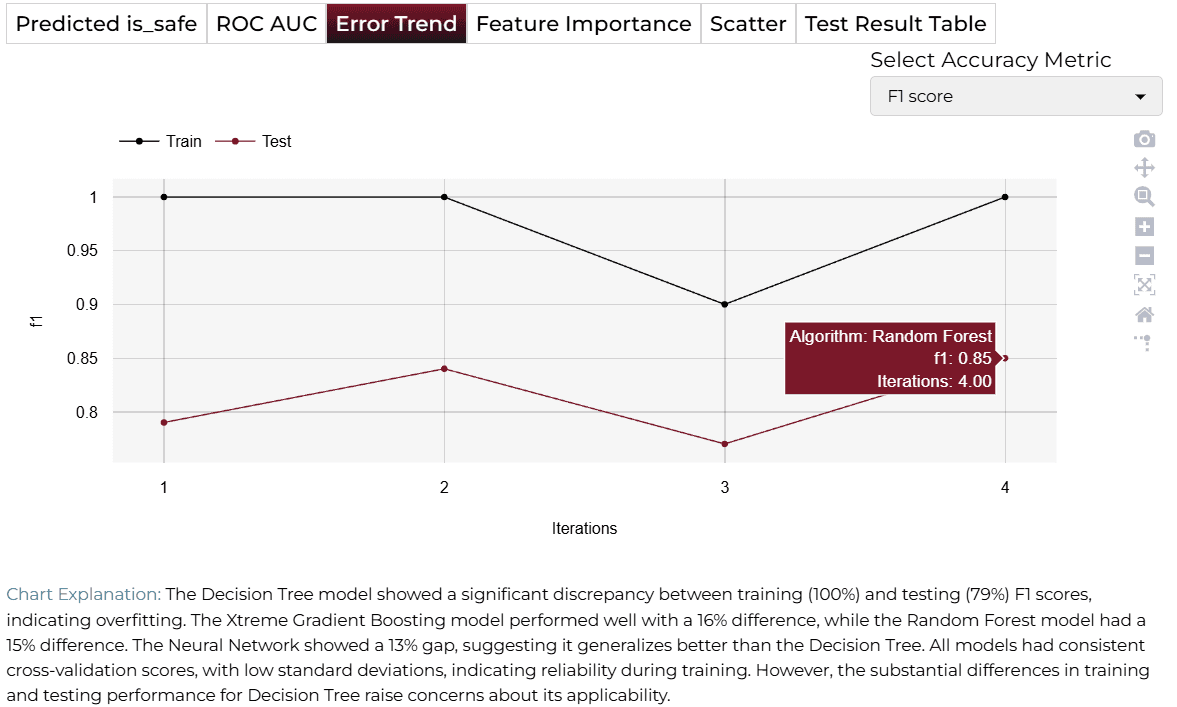
Random Forest achieved 85% accuracy using 5-fold cross-validation. While identifying patterns effectively, the model's performance suggests the need for ongoing regional data updates.
Training Analysis Details
APredicted Target (Confusion Matrix)
BROC AUC
CError Trend (F1 Score)
DFeature Importance
Finalize Models
Customize configurations and train until Accuracy is optimized. Once satisfied, click 'Deploy' to launch your AI application.

4AI APPLICATION
Manual Model Building
In Manual Training Mode, users can modify sliders for variables like cadmium and perchlorate. Clicking ‘Get Response’ generates a tailored water safety prediction.
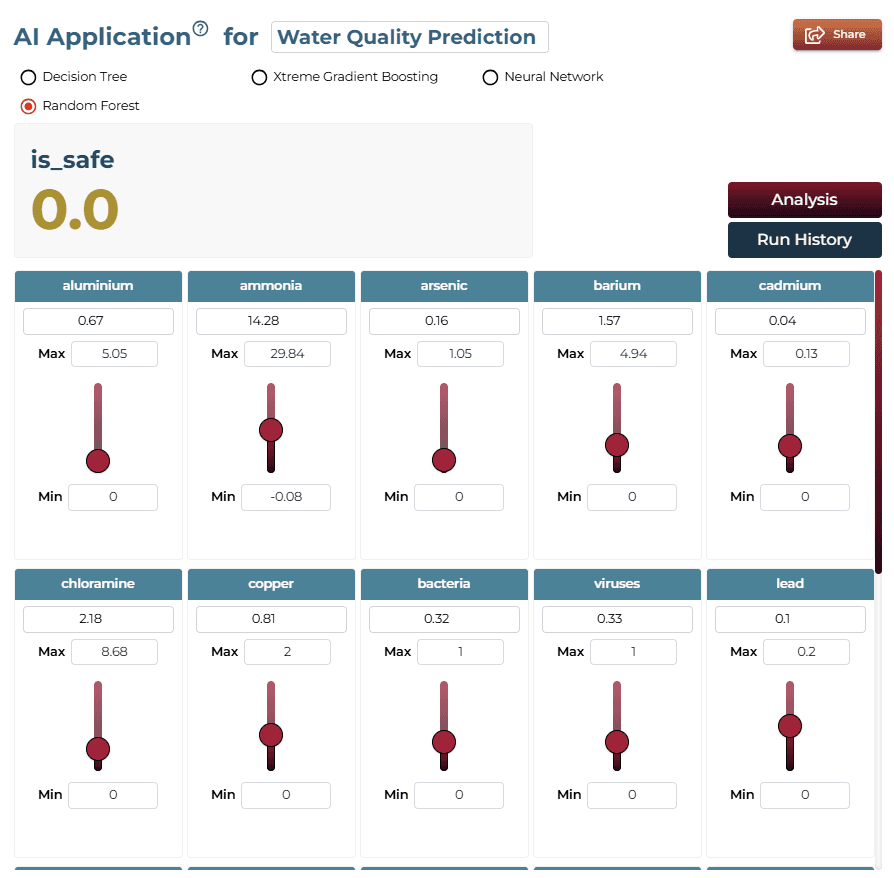
AI Application Demo
- Adjust water quality variables like 'aluminium' and 'arsenic'.
- Observe how different levels of contaminants influence safety classification in real-time.
Saving the Project
Save your project by clicking the icon at the bottom left corner of the textbox.

Sharing the Project
Share the application for single on-demand predictions once the analysis is saved.

Interested in similar AI solutions?
Explore our full suite of AI capabilities designed to transform your business operations.